

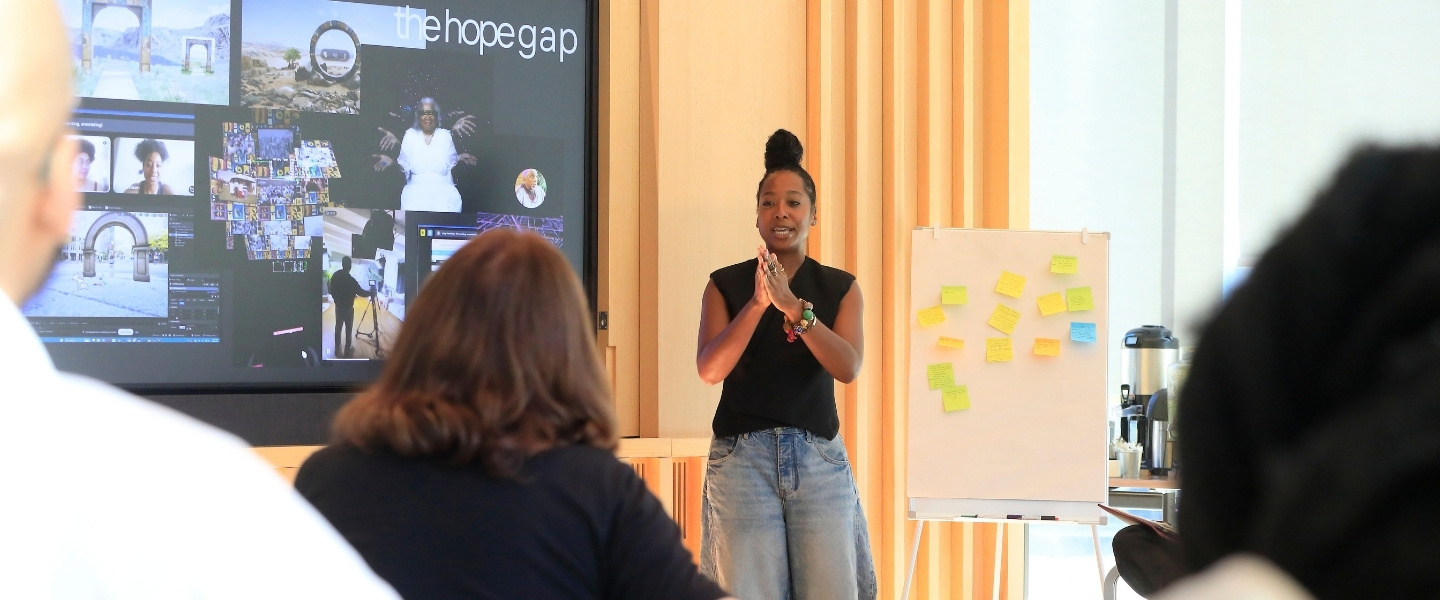
I began this work lying on the floor of a marae in Aotearoa/New Zealand, in tears, scribbling a poem, trying to make sense of what my heart felt. At a convening centering the Māori experience in global justice and transformation, hosted by the Atlantic Institute, I had witnessed harm repaired with dignity: mana restored and reintegration in place of punishment. Surrounded by other Fellows on sleeping mats in a sacred Māori meeting ground, I felt, somatically, systemic repair for the first time. Though historical legal settlements of financial redress, land returns and formal apologies were a foundation for the cultural reintegration of the Indigenous Māori people, witnessing that process gave me a sense of possibility.
I began to think about my whānau (a Māori term that translates to family), and my father’s lifelong advocacy work across the United States. The Southern Black Belt bludgeoned his mental health and durability. He, with others, fought to rectify the generational effects of chattel slavery and Jim Crow, to repair the impacts of colonialism and grave human rights abuses. We could argue, legislate and march for miles, but we had never fully bore witness to the world we wanted — it didn’t exist yet. Some 7,000 miles away from home, the Māori experience lifted a cloud for me, giving me an emerging sense of ka puta, ka ora (wellness and light). The question then became, “How do you build toward a future your body has never witnessed, or may never fully believe in? And, if our disbelief is connected to the difficulty in perceiving alternative futures as real, can embodied, immersive experiences make them real enough to trust?”
Across disciplines, belief becomes the bottleneck between endorsement and action. But what informs our beliefs and, most importantly, how do we shift them?
Researchers have a name for this ache: a hope gap. Yale climate scientists and media researchers use the phrase to explain the public’s inability to see solutions to a crisis they fear. Development economists have shown, experimentally, that raising hope changes behavior. School psychologists find that a student’s hope predicts achievement better than test scores do. Across the U.S., reparations movements are finding that hope, not support, predicts who actually donates, volunteers and acts. “Hope is contagious,” they write, “when it becomes tangible.”
In movements featured within The Hope Gap XR, those numbers are stark. While more than three-quarters of Black Americans support reparative policies, barely one in five believes they are achievable. This gap is not a personal failing but a structural condition. When systems show you, generation after generation, that certain changes are enormous feats — with progress backtracked at the whim of political waves —imagination itself becomes a contested terrain. Leading Black thinkers Frantz Fanon, Ngũgĩ wa Thiong'o and Steve Biko understood this long before Western psychologists named it: domination works on the mind and transformation requires extending the limits we've internalized.
Across disciplines, belief becomes the bottleneck between endorsement and action. But what informs our beliefs and, most importantly, how do we shift them?
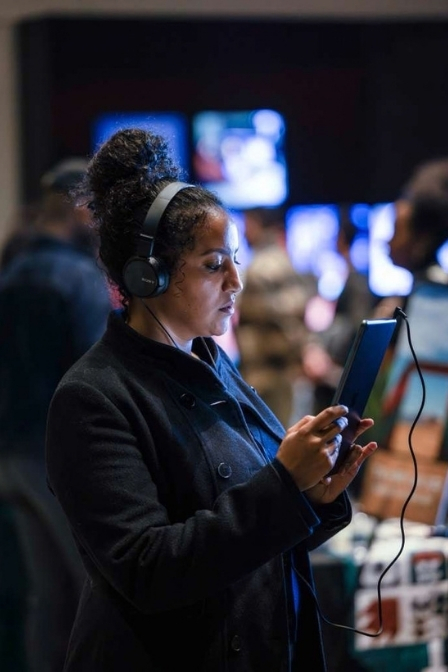
In 2024, the Atlantic Institute’s Emerging Technologies Lab supported my exploration of this question. With technical support from the Institute’s Emerging Tech team (Alice Wroe and Richard Smith), we built a mobile phone-powered augmented reality experience setting Linda Bilmes and Cornell William Brooks' research on U.S. reparative precedent to a soundscape with something a body could encounter. This XR experience premiered in Oxford, U.K., at the Global Atlantic Fellows Welcome, then later traveled to Illinois in the U.S., for the National Symposium for State and Local Reparations, followed by the Riot to Repair Soundscape Exhibition, presented by partners including Media 2070, ZEAL Co-op and Axel Impact Studio.
Participants stitch, and the small, rhythmic, deliberate gestures accumulate in a similar way to the process of policy and repair. The experience invites participants to recognize their own community, lineage and capacity in what’s already underway.
We found that people didn't need to be persuaded that repair to colonial impacts in the U.S. was the right thing to do but they needed proof that this process was already underway. So we captured where it was underway, virtually.
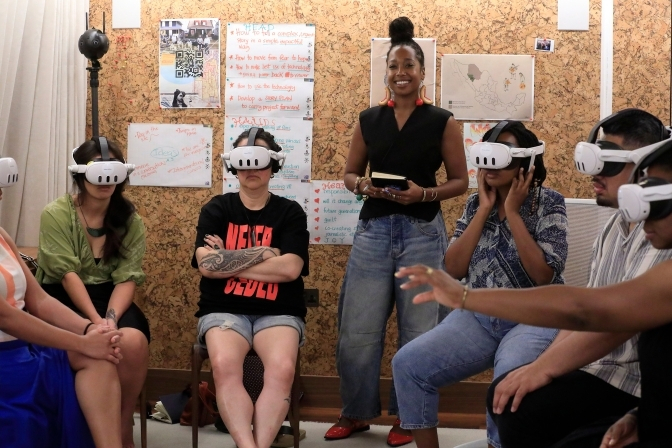
In 2025, self-taught and in partnership with GRX Immersive Labs, I produced a 15-minute virtual reality vertical slice carrying participants into Evanston, Illinois, home of the United States' first municipal reparations program, with previews of present-day reparative progress in Namibia and Aotearoa. A guiding presence, carrying the lineage of pioneering women across global reparations and climate justice movements, serves as the narrator and compass. Participants stitch, and the small, rhythmic, deliberate gestures accumulate in a similar way to the process of policy and repair. The experience invites participants to recognize their own community, lineage and capacity in what’s already underway.
Forty impact leaders from six countries screened the work in progress at Oxford; community feedback in Accra, Evanston, Los Angeles and Atlanta has helped refine the script and pedagogy. We have also adapted the experience to complement the Octavia Butler Lecture Series at the Smithsonian's National Museum of African American History and Culture, in dialogue with Dr. Ruha Benjamin's call to move from artificial intelligence to abundant imagination.
With support from Agog: The Immersive Media Institute, a philanthropic organization founded by Chip Giller and Wendy Schmidt to advance XR for social good, we are now building the Possibility Portal: a deeply curated archive of stories of community-led repair, drawn from people worldwide already living the futures we struggle to picture. Each story is built in depth and stitched to the others, allowing the archive to weave together a fully realized world.
The Possibility Portal will put repair at its center. In 2027, this walk-through installation will activate at the National Museum of African American History and Culture and come home to Atlanta, where visitors will cross a threshold, add a thread to a communal loom, wander a living map and, ultimately, contribute an act of their own.

Injustice, especially for Indigenous women, persists in Aotearoa, as in most parts of the world. But models of progress are worth latching onto, and spreading them like wildfire. Because hope is a system; imagination is infrastructure; and repair is a process. All three are scaffolded by beliefs, informed by stories: the ones we inherit, the ones we’re told and the ones we’ve been denied.
I never completed the poem I began on that marae. I don’t think I was meant to. I was meant to build it instead: a place where what happened to me by circumstance could happen to others on purpose, so that the next person fighting my father’s fight won’t need to cross an ocean to feel the possibility of another world. So that the next person can make hope tangible.
How irresistible must this world be for you to believe in its possibility?
About the author
Dela Wilson is a strategist, facilitator and immersive experience designer, and an Atlantic Fellow for Racial Equity. She is the founder and principal of Axel Impact Studio, a narrative strategy and experience design studio that helps leaders, institutions and governments build what comes next. Dela created The Hope Gap XR, an immersive storytelling platform supported by the Atlantic Institute and developed with GRX Immersive Labs, and leads The Possibility Portal, its companion public platform backed by Agog. She has advised Bloomberg Philanthropies' multi-city grantmaking portfolio, led Washington, DC's first participatory grantmaking program and partnered with governments across the Caribbean on cultural affairs and preservation strategies. A speaker and convener, she's earned degrees from Spelman College, Georgetown Law and Harvard Kennedy School.


.png)

